Holly Springs was chartered in January 1877 and turns 150 this season. Its National Register sites, historical markers, founder's grave and how to visit them.
Last checked Oct. 11, 2026. Facts on this page come from the Town of Holly Springs history pages and historic preservation page, and the N.C. State Historic Preservation Office’s National Register listings.
The N.C. General Assembly chartered the Town of Holly Springs in January 1877, according to the town. It started as a town of one square mile and 218 people; today it covers about 19.88 square miles. The town’s yearlong 150th anniversary celebration runs through May 2027.
Visit and learn more
- Historical Marker Tour and Black History Tour: self-guided walking tours on your phone, from the town’s marker program page and history pages
- Town records back to 1909: Town Clerk’s Office, 919-557-3900, 8:30 a.m. to 4 p.m. business days by appointment
- Holly Springs Cemetery: 451 W. Earp St.; cemetery@hollyspringsnc.gov
- Mims Park and the founder’s grave: 350 W. Ballentine St., sunrise to sunset
How Holly Springs began
The land that became Holly Springs was home to the Tuscarora before Europeans arrived. Colonial land grants date from the 1750s through the end of that century, and early settlers built grist mills and sawmills, farmed and ran a tavern for travelers bound for Raleigh by way of Avent’s Ferry on the Cape Fear River, the town says.
The town offers two stories for its name. One credits two large holly trees near a spring by the first Holly Springs Baptist Church. The other traces it to 1779, when a surveyor recorded “Holland’s Spring Branch” as “Holley Spring Branch.”
A timeline
- About 1805: Needham Norris builds the Norris-Holland-Hare House, the town’s oldest structure. Union soldiers used its first floor as a field hospital for two weeks in April 1865.
- 1817: tailor Archibald Leslie arrives; by 1840 his house on Avent Ferry Road is under way.
- Early 1850s: the Masonic Lodge on Raleigh Street is completed; masons begin meeting there around 1852.
- 1854: the Raleigh Baptist Association opens the Holly Springs Academy.
- 1865: at the end of the Civil War, Union Maj. Gen. Jefferson C. Davis uses the Leslie house as headquarters for two weeks.
- 1876: Col. George B. Alford acquires the Leslie house and adds to it.
- January 1877: the town is chartered.
- 1908: the first public school opens, for white students; the Cultural Center stands on the site.
- 1920s: Holly Springs Elementary, a Rosenwald school for Black children, opens on the site of today’s W.E. Hunt Recreation Center, named for its longtime principal.
- 1973: James Norris and William Bernice Lassiter become the first Black town commissioners; Norris becomes the first Black mayor in 1980.
- 1981: Dessie Mae Womble becomes the first Black female police chief in North Carolina.
- 2006: Novartis, now CSL Seqirus, announces a vaccine plant, followed by FUJIFILM and Amgen.
- November 2021: UNC Rex Holly Springs Hospital opens.
National Register of Historic Places
From the State Historic Preservation Office’s listings:
| Property | Where | Listed |
|---|---|---|
| Leslie-Alford-Mims House | 100 Avent Ferry Road | March 8, 1997 |
| Utley-Council House | Holly Springs vicinity | May 16, 2002 |
| Samuel Bartley Holleman House | 3424 Avent Ferry Road, New Hill vicinity | Jan. 30, 2008 |
| Holly Springs Masonic Lodge | 224 Raleigh St. | April 7, 2010 |
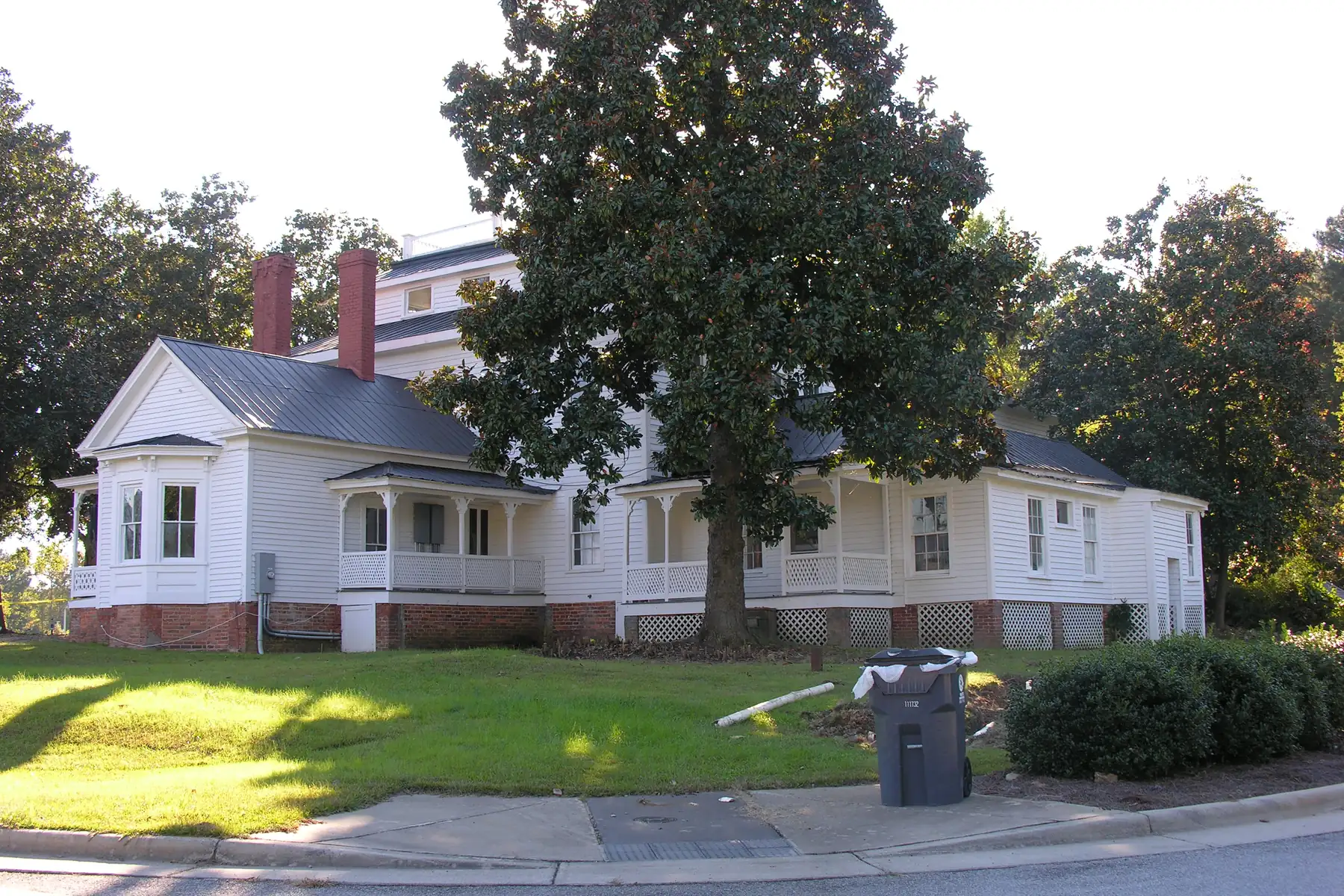
- Leslie-Alford-Mims House: a 38-room house begun by Archibald Leslie and enlarged by the Alford and Mims families, also a local historic landmark, according to the town.
- Holly Springs Masonic Lodge No. 115: a Greek Revival-influenced building from the early 1850s, one of the oldest lodge and school buildings in Wake County. It housed the town’s earliest school and the first open to girls, and students’ graffiti survives on the upstairs pine walls. Masons still meet there.
- Samuel Bartley Holleman House: a 1913 Queen Anne-Colonial Revival house at Holleman’s Crossroads, outside town limits but in the town’s planning area, with a smokehouse, well house and other 1913 outbuildings.
These are private properties; the town does not publish visiting hours for them.
Markers, parks and the cemetery
The town’s historical markers include the Masonic Lodge; the site of Mims Drugstore on Center Street; the former grist mill at Bass Lake Park; Holly Springs School at the Cultural Center; the Norris-Holland-Hare House; the former Holly Springs Elementary at the Hunt Center; and the site of Revolutionary War patriot Christopher Woodward’s mill and store.
Mims Park, 350 W. Ballentine St., holds natural springs and the grave of G.B. Alford, whom the town calls its founder. Holly Springs Cemetery, on 8.54 acres at Earp and Burt streets, holds graves of founding families on land that once held an all-boys preparatory school and a church.
What this means for you
- Walk the marker tour downtown during the 150th anniversary season.
- HollyFest on Oct. 31 includes a town history timeline display.
- Researching family history? The Town Clerk’s scanned records go back to 1909.
More: Holly Springs population and growth and parks and trails.
Frequently asked questions
When was Holly Springs, NC, founded?
The N.C. General Assembly granted a charter incorporating the Town of Holly Springs in January 1877. Land grants in the area date from the 1750s, and the town is marking its 150th anniversary through May 2027.
How did Holly Springs get its name?
The town gives two explanations: holly trees that stood near a spring by the first Holly Springs Baptist Church, or a 1779 surveyor who recorded Holland’s Spring Branch as Holley Spring Branch.
What is on the National Register of Historic Places in Holly Springs?
The Leslie-Alford-Mims House (listed 1997) and the Holly Springs Masonic Lodge (2010) in town, plus the Utley-Council House (2002) and the Samuel Bartley Holleman House (2008) nearby.
What is the oldest building in Holly Springs?
The town calls the Norris-Holland-Hare House, a Federal-style house built around 1805 off Avent Ferry Road, Holly Springs’ oldest structure. It is a private home.
Where is the founder of Holly Springs buried?
The grave of G.B. Alford, whom the town calls its founder, is on the natural-surface loop trail in Mims Park, 350 W. Ballentine St., open sunrise to sunset.
Have your say